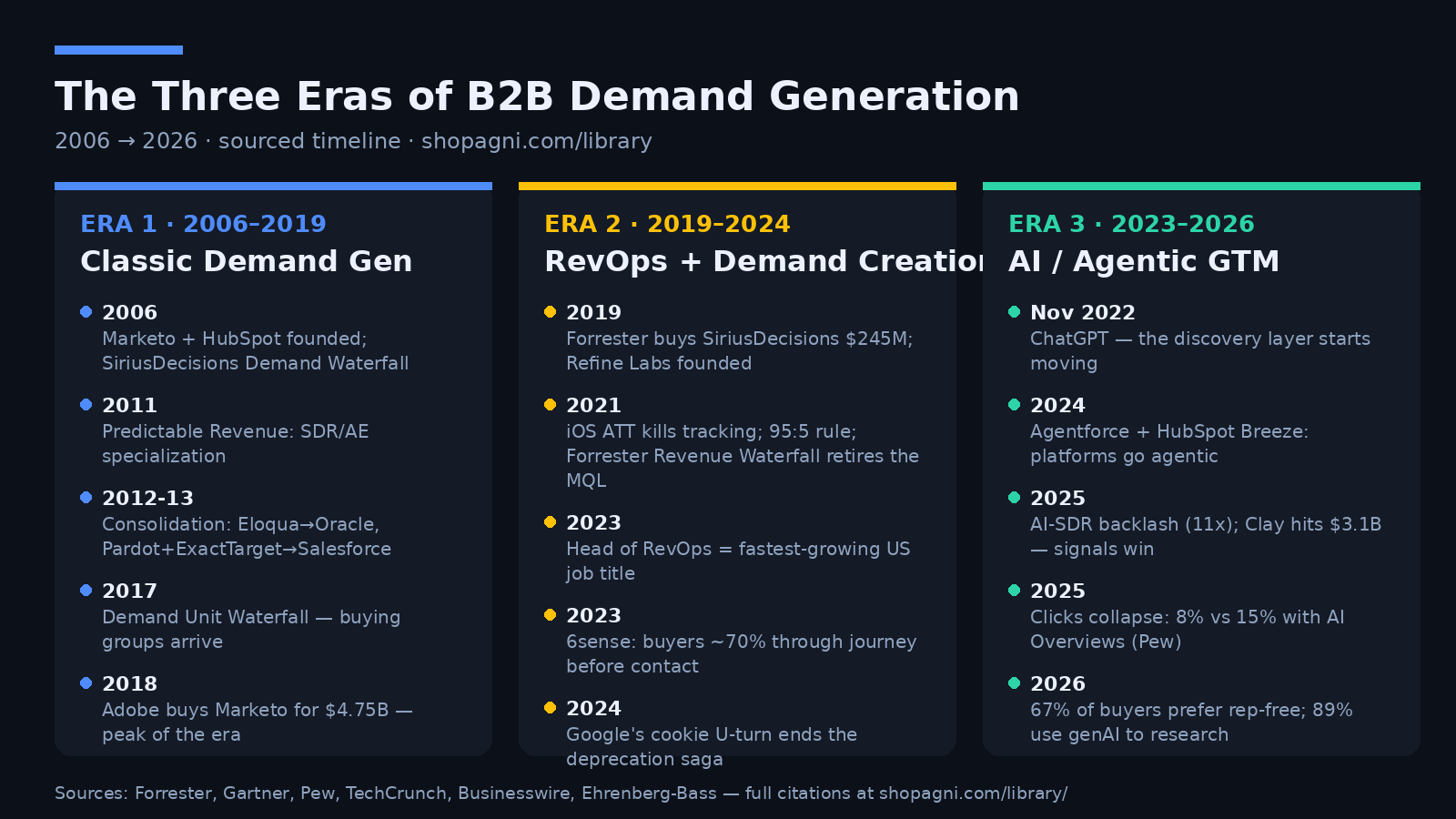
The short answer: B2B demand generation has moved through three eras. In Era 1 (2006–2019), information was scarce and gated, so form-fills were real intent — the MQL waterfall worked. In Era 2 (2019–2024), buying went dark (communities, podcasts, privacy walls) and RevOps + demand creation replaced the lead factory. In Era 3 (2023–today), AI answer engines moved the discovery layer itself: 89% of B2B buyers now use generative AI as a top self-guided research source (Forrester), and 67% prefer a rep-free experience (Gartner, 2026). Each era’s playbook was rational for its constraints — and deadly when carried into the next one.
A note on how we write: claims tagged [Established] are sourced consensus, [Field note] is what we see in real engagements (anonymized), and [Take] is our opinion — argue with us.
Era 1 (2006–2019): the MQL machine — and why it actually worked
[Established] The modern demand-gen stack was born in 2006: Marketo and HubSpot were founded the same year SiriusDecisions introduced the Demand Waterfall — Inquiry → MQL → SAL → SQL → Close (Forrester). Aaron Ross’s Predictable Revenue (2011) added the SDR/AE specialization model. The era’s logic: information was scarce and gated, so a form-fill was a genuine intent signal. Gate the whitepaper, capture the email, score the behavior, route to sales.
[Established] The era ended in a consolidation frenzy: Oracle bought Eloqua for ~$871M (2012), Salesforce absorbed Pardot via ExactTarget ($2.5B, 2013), and Adobe paid $4.75B for Marketo in 2018 (CNBC) — a 5.5× multiple on Eloqua’s exit six years earlier. Notably, SiriusDecisions itself replaced the lead-based waterfall with the buying-group-based Demand Unit Waterfall in 2017 — before “the MQL is dead” became a LinkedIn genre.
[Take] The revisionist history that “MQLs were always stupid” is wrong. The MQL was a rational instrument for its information environment. The mistake wasn’t inventing it — it was running it for a decade after the environment changed.
Era 2 (2019–2024): buying went dark, and ops grew up
[Established] Two forces broke Era 1. First, buyer behavior moved to channels marketing couldn’t track — “dark social” was coined by Alexis Madrigal back in 2012 (The Atlantic), but Slack communities, podcasts, and peer recommendations made it dominant. Second, privacy: Apple’s App Tracking Transparency shipped April 2021, and Google’s third-party-cookie deprecation saga ended in a full U-turn by 2024.
[Established] The institutional response was RevOps: Forrester acquired SiriusDecisions for $245M (January 2019), and by 2023 “Head of Revenue Operations” was the fastest-growing job title in the US (LinkedIn, via Forbes). The ideological response was demand creation: Chris Walker’s create-vs-capture framing, backed academically by the Ehrenberg-Bass 95:5 rule (2021) — up to 95% of your buyers are out-of-market at any moment. Forrester’s 2021 B2B Revenue Waterfall formally retired the lead as the unit of measurement: 95% of purchases involve 3+ people from 2+ departments.
[Field note] Every lifecycle rebuild we’ve run confirms the era-2 diagnosis: the leak is almost never campaign volume, it’s definitions and routing. Redefining the MQL with sales in the room — plus behavior-based scoring and capacity-aware routing — lifted MQL→SQL conversion at one B2B SaaS engagement with zero new tools.
[Take] The 95:5 rule is a derivation from purchase-cycle math, not a survey finding — treat it as a robust heuristic, not a measurement. It’s still the single most useful budget-allocation idea of the decade.
Era 3 (2023–2026): AI moved the discovery layer
[Established] ChatGPT’s launch (November 30, 2022) started the largest shift in buyer research behavior since Google. The numbers, as of 2026: 89% of B2B buyers use genAI as a top self-guided research source (Forrester); 67% prefer a rep-free experience (Gartner, March 2026); users click a result on just 8% of searches with an AI Overview vs 15% without (Pew, 2025). Search didn’t die — clicks did. And the traffic that survives converts: 58% of marketers say AI referral traffic has much higher intent, and HubSpot reports its own LLM-sourced leads are up 1,850% and convert 3× better (HubSpot State of Marketing 2026, n=1,505).
[Established] The era has already had its bubble: the “AI SDR” category promised digital employees, then flagship 11x was found claiming customers it didn’t have, with early churn estimated at 70–80% (TechCrunch, March 2025). What scaled instead was signal-based GTM — Clay reached a $3.1B valuation and 10,000+ customers (Businesswire, Aug 2025) — and platform agents under human governance (Salesforce Agentforce, HubSpot Breeze, both launched September 2024).
[Take] Era 3’s winning posture is the same discipline both previous eras lacked at their peaks: bounded autonomy. Agents run the routine layer under audit; humans own judgment and trust moments. The teams that burned budget on “AI employees” in 2024–25 made the Era-1 mistake at Era-3 speed — automating on top of a broken data estate just automates the error faster.
What each era teaches the next
- Era 1 → instrument decay: every intent proxy (form-fill, MQL score, click) degrades as the environment changes. Audit your proxies annually.
- Era 2 → dark-funnel humility: software attribution systematically undercounts what drives pipeline; pair it with self-reported attribution (Refine Labs).
- Era 3 → machine-legibility: your buyers’ first “advisor” is now often a model. Structure content so it can be retrieved and cited (answer-first, sourced statistics, schema) — the Princeton GEO research measured up to 40% visibility gains from exactly this.
Frequently asked questions
Is the MQL dead in 2026? As a unit of measurement, largely yes — Forrester’s Revenue Waterfall replaced it with buying-group opportunities in 2021. As an operational handoff contract between marketing and sales, no: teams still need a co-signed definition of “qualified,” whatever they call it. [Field note] Rebuilding that contract remains the highest-ROI fix we see.
What replaced the demand waterfall? Forrester’s B2B Revenue Waterfall (2021), built on opportunities and buying groups rather than individual leads — reflecting that 95% of B2B purchases involve 3+ people.
Did AI kill B2B search traffic? Query volume held; clicks collapsed. Pew found an 8% click rate on searches with AI Overviews vs 15% without, and Ahrefs measured a 34.5% CTR drop for #1 results. Meanwhile AI-referred visitors convert at materially higher rates — fewer, better clicks.
What is demand creation vs demand capture? Creation educates the ~95% of buyers not yet in-market (podcasts, social, community); capture converts the ~5% who are (search, AI answers, review sites). The framing comes from Chris Walker/Refine Labs; the math from Ehrenberg-Bass’s 95:5 rule.
What should a demand gen team do differently in 2026? Three moves: (1) fund demand creation for future buyers, (2) make everything machine-legible for AI answer engines, (3) run agents on the routine layer under bounded autonomy — with the data-hygiene work done first.
Sources for every date and figure above are linked inline; the full research bank — including the reports we hold on file — lives in The Library. Spot an error? Tell us — corrections are part of the product.